
by Organisasyon dagiti Nakurapay nga Umili iti Siyudad
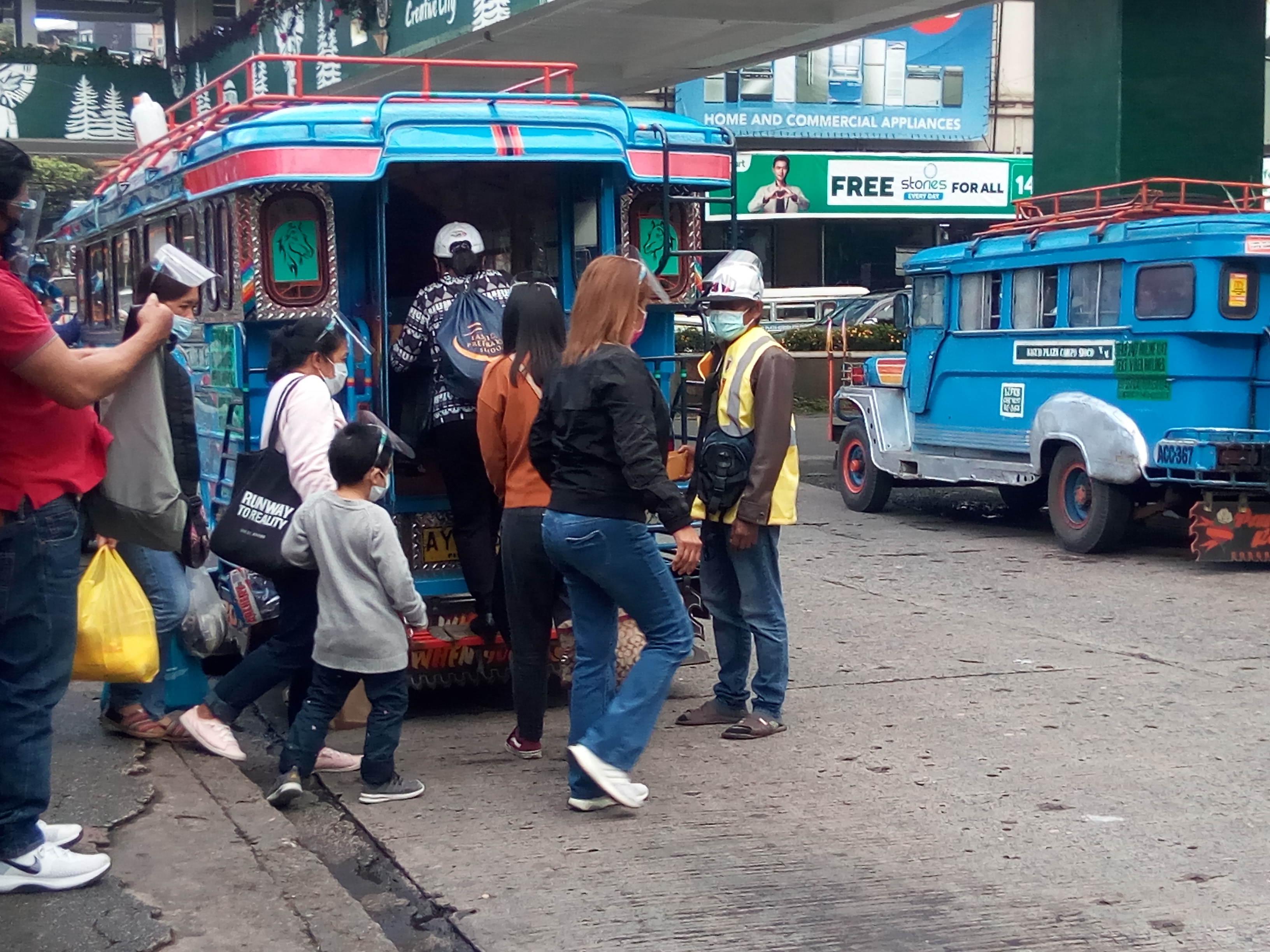
Maximum load: half of seating capacity
The public transportation sector is one of the hardest hit sectors by the Covid-19 outbreak. The Enhanced Community Quarantine (ECQ) implemented during the lockdown’s early phase limited the operation of the transport sector to keep people from going out of their homes. The jeepney sector agreed to this guideline to prevent the spread of the virus, thus the majority of jeepney units did not run.
Such restrictions on mobility however caused economic difficulties for public utility drivers. “Nung nagkaroon tayo ng emergency quarantine nung last March, ayun na nagkandahirap-hira na, yung mga taxi, jeepney, UV express and bus companies na pinahinto ng pandemic na ito, kaya malaki yung epekto sa kabuhayan namin na mga drayber at maliit na operator (When we had the emergency quarantine last March, it became really difficult for us – taxis, jeepneys, UV express, and bus companies. This pandemic halted our operations. That’s why its impact on our livelihood as drivers and small operators has been huge),” declared Josefino Bautista who has been driving a jeepney for 10 years.
David Aragon, a jeepney operator, concurred, “Agbisin kami nga drivers gapu ta awanen ngarud ti panggedan, dakami ket nu anya ti nabati ti krudo isu laeng ti bagi mi, isu nga idi nalockdown awanen ah ti pangalaan mi ti kasapulan mi ti inaldaw-aldaw. (We drivers went hungry since we no longer had any source of livelihood. We only live on whatever is left after gasoline expenses, so during the lockdown we didn’t have any income source anymore for our everyday needs.)”
Restrictions
During the lockdown, the Barangay Local Government Units (BLGU) ensured a minimal number of jeepney units to ply their routes for residents and only within certain window hours. This arrangement became very difficult for most employees who still had to go to work during ECQ and depended on mass transportation to commute. Some barangays set up transportation for employees and frontliners but it was very limited resulting in long lines of commuters. The Irisan Jeepney Operators and Drivers Association (IJODA), which has one of the biggest jeepney fleets in Baguio city at 89 units, was given a permit to run only 12 jeepneys every day. Some jeepney routes have fewer units allowed to operate. The Tomay Greenfield Incorporated (TGFI), for instance, which plies routes in Baguio and La Trinidad, was permitted to operate only three of its 100 jeepneys but these were not allowed to enter Baguio due to lockdown restrictions. Other jeepney routes to Baguio were also suspended, such as Itogon to Baguio, Tuba to Baguio, and Sablan to Baguio.
There are about 300 jeepney units designated to different routes within Baguio City including routes from the adjacent municipalities of La Trinidad, Itogon, Sablan, Tuba, Tublay (LISTT). Using this as a basis, it is estimated that around 3,000 public utility jeepney (PUJ) drivers and 3,000 operators have less or no income at all during the quarantine period. This does not include the number of families and other groups that depend on jeepney operations. Also, only about 100 jeepney units have been allowed to operate in the whole city during ECQ and the subsequent General Community Quarantine (GCQ) periods.
Most drivers and small operators largely depend on their everyday income. Thus, for the more than five months that the lockdown has been imposed, they have faced livelihood insecurity which impacts their families. “Awan met ti dadduma nga alternatibo ta lockdown met, inka ag ag-utang tatnu adda ti maisa-ang. Isu nga kalpasan daytuy covid ah ket kabutbuteng nga utang ti sangoen tu manen nu sumaruno (We do not have other alternatives because we’re under lockdown. The only option left is to borrow money to put food on the table, so after this pandemic we will face frightfully huge amounts of debt),” Aragon further said.
The government promised to give assistance, but until now the transportation sector has not received any. Some received cash assistance under the Social Amelioration Program (SAP) of the Department of Social Welfare and Development (DSWD), but the majority did not receive aid from the Land Transportation Franchising and Regulatory Board (LTFRB), the agency designated to provide assistance to drivers and operators.
Permit to operate
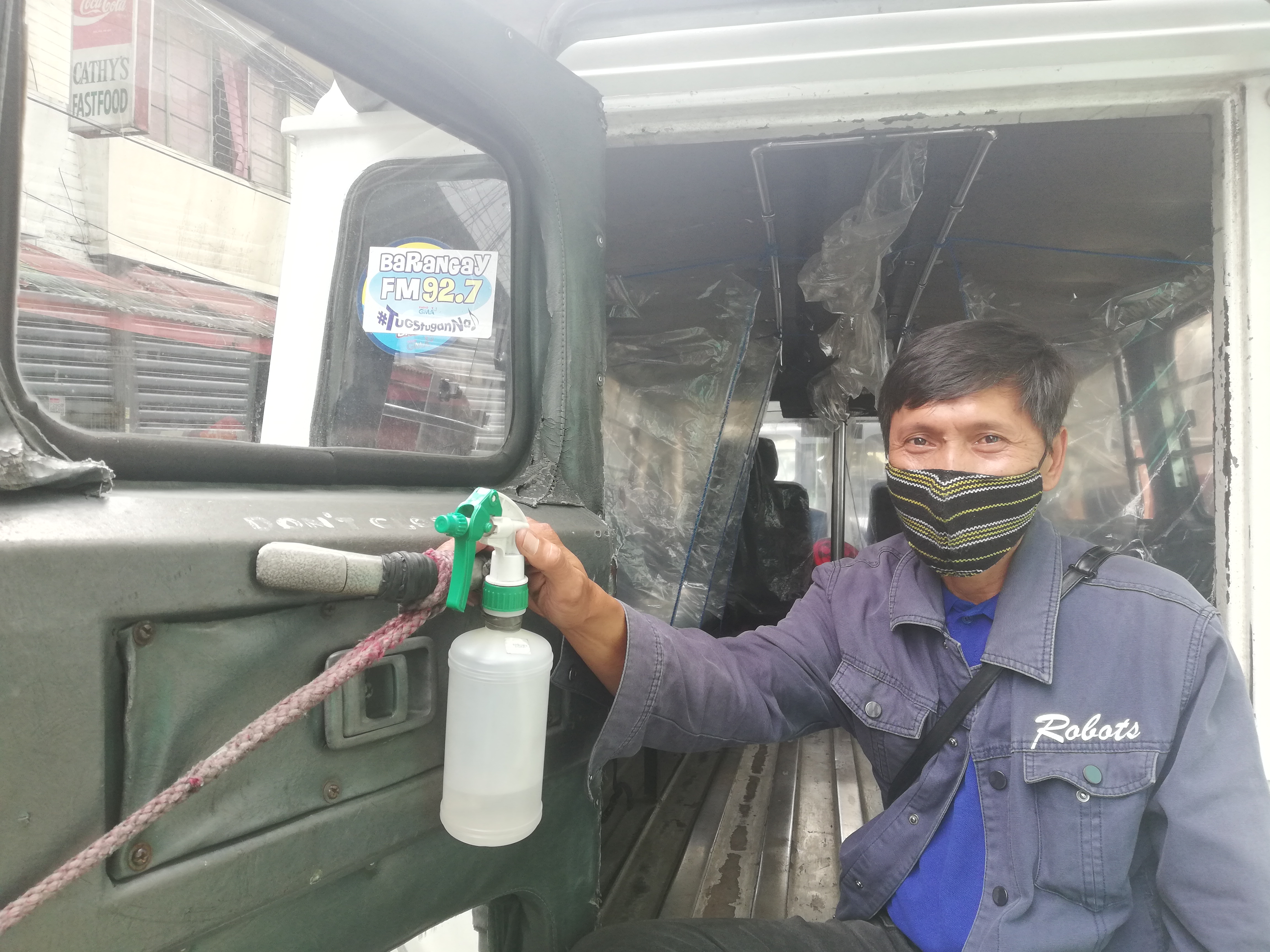
Observing health protocols to be able to operate
Under LTFRB guidelines issued on May 1 when more public transportation was opened for GCQ areas, drivers need a special permit to operate. To secure this permit, they need to comply with various requirements: a valid franchise or Certificate of Public Convenience (CPC), pass roadworthy inspection by the Land Transportation Office (LTO), and be included among the authorized units owned by a juridical entity such as a cooperative or corporation. The guidelines also include other requirements to prevent spread of the coronavirus. Drivers, conductors, and passengers should wear masks. Drivers should provide shoe-disinfectant for passengers prior to boarding. Physical distancing should be strictly observed, thus each jeepney should only carry half of its seating capacity.
Driver’s compartment should be sealed off from the passenger area, and passengers should be one seat apart separated by impermeable barriers. In addition, the vehicle should be disinfected at every end of a trip.
But in addition to all these requirements, the LTFRB permit makes it virtually impossible for drivers to operate. As Aragon explained, “Ti permit nga isaksakat iti LTFRB nga maaramid ket mang-ikkat iti trabaho kadagiti kaaduan. Kadagiti amin nga association adda ti maysa, adda ti duwa unit nga maipalubos nga maikkan ti permit. Innikkat da pay laeng ti kasla gundaway mi kuma nga agbiyahe ta isu lang kuma ti panggedan mi dayta. Pakabiyahiam ya tapnu nu kasta ket mabiyag kami ken mabayadan mi ti inut-utang mi idi ECQ.” (The special permit required by the LFTRB leads to loss of livelihood for the majority of drivers/operators because only one or two units in each jeepney association are allowed to operate. They removed whatever opportunity we have to make a living especially at this time. We have to operate for us to live and to be able to pay back the money we borrowed during the ECQ.)”
Pushing PUV modernization despite pandemic
A major issue confronting the jeepney sector even before the pandemic was the Public Utility Vehicle (PUV) Modernization Program, which aims to modernize the current PUV fleet, reform and consolidate the industry, and move towards an environmentally sustainable transport system. Since 2015, the LTFRB has issued a series of memoranda on the implementation of the program including the tedious process and unaffordable requirements. The program will phase out traditional jeepney units based on guidelines defined by the Department of Transportation (DOTr) and LTFRB.
Even as the transport sector is facing livelihood insecurity during this health crisis, the government is bent on undertaking the modernization program. Phasing out the traditional jeepneys is LTFRB’s priority. This clearly shows that the government is using the pandemic to push for PUV modernization, which is definitely not pro-people. In the National Capital Region (NCR), modern jeepney units are prioritized to operate in available routes, with traditional jeepneys being considered only to fill up a lack if any and only up to such time when modern units are available. The Cordillera Administrative Region is implementing the modernization program phase of franchise consolidation, since there are as yet no modern jeepneys. The Baguio City Government in addition has issued a resolution disallowing the PUV modernization program because its modern jeepney design is inappropriate to the city’s terrain. It only issues a special permit to operate to those jeepneys which entered into franchise consolidation. The City Government permitted 180 jeepney units to operate under ECQ which it increased to 974 units under GCQ on June 1.
The strict guideline for securing a special permit, especially the insistence of using modern jeepneys, limits the right to livelihood of drivers and small operators. In addition, the LTFRB and DOTr are pushing to create a temporary Local Public Transport Route Plan (LPTRP) or Route Rationalization. The LPTRP, which can become permanent, is a main requisite of the PUV modernization program. Many existing routes will disappear if franchise consolidation is not done, or these can be bidded out to other jeepney cooperatives or corporations.
Jeepney associations are opposing the modernization program as it means loss of livelihood for many drivers and small operators. The transport group Pinagkaisang Samahan ng Tsuper at Operator’s Nationwide (PISTON) Baguio-Benguet chapter has criticized it for being anti-people. The group has been conducting regular mass protest actions in front of the DOTr and LTFRB offices to raise their concerns and recommendations to improve the transport sector without putting operators’ and drivers’ livelihoods at stake. It has submitted position papers against the program and called for support from the local government.
PISTON Baguio-Benguet chapter leader Carlito Wayas said, “Ti kayat da nga agbiyahe itatta nga GCQ ket dagiti barbaru nga moda ti transportation. Dagiti kanu jeepney nga dati nga agbabiyahe ket nu agkurang ti modernized nga jeepneys ket isu da ti pang-back up. Adda pay jay kunada nga masapul nga suruten da dijanay year modeling, nga nu 2005 pangatu isu kanu laeng ti mabalin nga agpasada. Dagijay bumaba dijay ket haan dan nga pumasada. Imbis nga tulungan da ka, ket parigaten da ka pay. (They only want modernized jeepneys to operate, traditional jeepneys will only serve as backup. Only jeepneys of model 2005 to the present are allowed to operate while older models can no longer run. Instead of helping drivers during this pandemic, they are making it more difficult for us.)”
Calls of jeepney sector
Leaders of the Baguio-Benguet Movement Against Jeepney Phaseout (BBMAJPJ) has drawn up a position paper submitted to the Baguio City Government containing their concerns and recommendations on government’s transport guidelines under the current less restrictive Modified General Community Quarantine (MGCQ). It includes the issues of PUV modernization program implementation amid the pandemic, LTFRB mandate to issue the special permit to operate and Local Government Unit’s role in recommending the number of jeepneys to operate. The BBMAJPJ has urged other associations in the LISTT area to submit a similar position paper in their municipalities. The movement calls for the following:
- On Special Permit. The LGU should issue the permit as carried out during the ECQ. Barangay LGU and jeepney associations should determine the number of units that will operate. Operation will be on rotation basis to ensure that all jeepney franchises can operate and are fairly given the opportunity to make a living.
- On Jeepney Fare. The fare will be based on the regular rates before the pandemic and passenger initiative to give more should be allowed until subsidies from the LGU are given.
- On LPTRP. It is not timely to push for Route Rationalization. Concerned government agencies should focus instead in confronting the pandemic and work together to get public transportation service back to the people including lost livelihoods of drivers and small operators.
- On Contact Tracing. Getting basic information of passengers can be carried out in jeepney terminals, which serves as the transport sector’s contribution to combat the Covid-19 pandemic.
- The assistance not received by the transport sector during ECQ should be given during MGCQ, considering the sector’s source of livelihood has not yet been fully restored.
The City Government of Baguio has passed a resolution stating that the permit will be issued by the LGU. However, the transport sector should still follow certain requirements of LFTRB. On LPTRTP, a particular loading and unloading area has been instituted for some jeepney trunklines.
The transport sector needs strong solidarity and undertake a spirited campaign against the PUV modernization program, which will monopolize transport ownership and management. It is essential to protect the livelihood of drivers and small operators and to fight for the people’s right to affordable and appropriate jeepney units.